Why winter was colder than average in the U.S., and what spring will bring

The Washington PostFollow

784.4K Followers

Why winter was colder than average in the U.S., and what spring will bring

Story by Ben Noll

 • 11h • 

4 min read
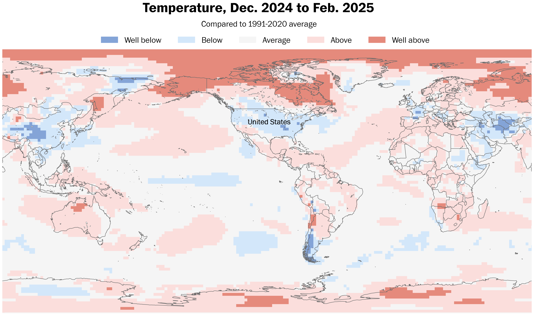
Why winter was colder than average in the U.S., and what spring will bring

Why winter was colder than average in the U.S., and what spring will bring© Ben Noll/The Washington Post/NOAA

Meteorological winter, which runs from December to February, ended this weekend. Not only did it give way to meteorological spring on March 1 in the Northern Hemisphere — it ended the coldest three month period in the United States since the winter of 2013 to 2014.

It was about 1.1 degrees below average as a whole in the contiguous United States, which was home to some of the most unusually cold air on the planet — a part of western Kentucky that was almost 7 degrees colder than average.

Despite the frigid temperatures, 67 percent of the country experienced below-average snowfall.

The meteorological definition for the seasons, based on historical weather statistics, differs from the astronomical definition. Astronomical spring begins on March 20.

But this next three month season will begin on a stormy, dangerous note, with severe thunderstorms and tornadoes possible in the South on Tuesday and strong winds in many regions this week, along with blizzard conditions, heavy rain and a temperature roller coaster.

An unusually cold winter
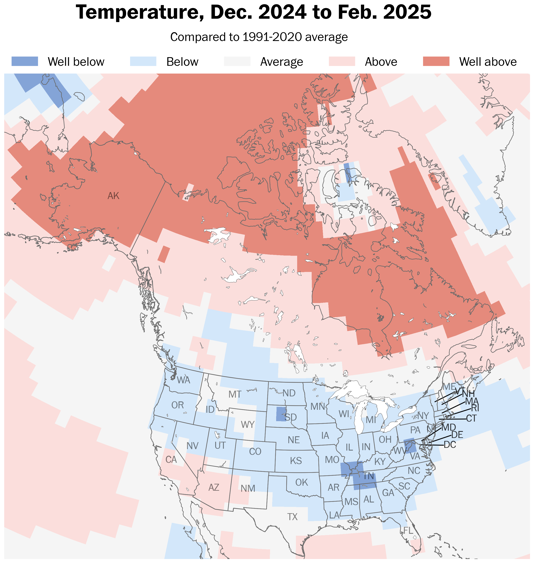
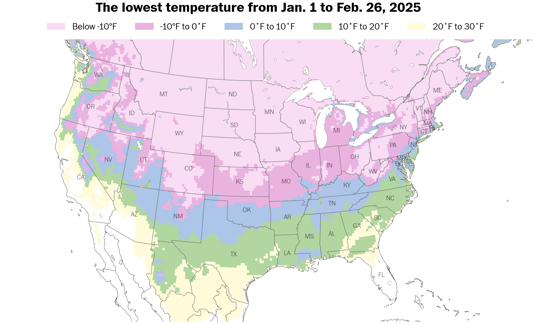
Parts of every state except Alaska and Hawaii experienced below-average temperatures this winter.

Parts of every state except Alaska and Hawaii experienced below-average temperatures this winter.© Ben Noll/The Washington Post/NOAA

Below-average temperatures covered parts of every state except Alaska and Hawaii this winter.

The most unusually cold conditions occurred in South Dakota and in a corridor that includes Illinois, Missouri, Kentucky, Tennessee, Arkansas, Mississippi, Alabama and Georgia as well as Pennsylvania, West Virginia, Maryland and Virginia.

The cold conditions were driven by high pressure in the Arctic, which caused the polar vortex to be displaced unusually far south, dislodging polar air masses into the United States.More than 111 million people across the United States have experienced subzero temperatures this year, the highest number in six years.

More than 111 million people across the United States have experienced subzero temperatures this year, the highest number in six years.© Ben Noll/The Washington Post/ECMWF/ERA5

Since the start of 2025, more than 111 million people across the United States experienced subzero temperatures, the highest number in six years.

One of the true temperature oddities of the season occurred in January when Anchorage was briefly warmer than parts of Louisiana, just 30 miles inland from the Gulf of Mexico.

The United States was part of the 8 percent of the planet that experienced below average winter temperatures. Meanwhile, 44 percent experienced above-average temperatures. Such a ratio is consistent with a warming climate.

Below-average snowfall
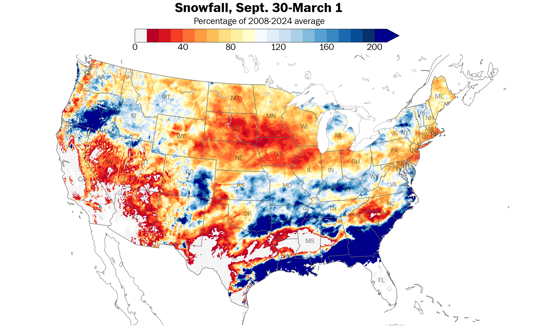
Below-average snowfall covered a majority of the United States this winter.

Below-average snowfall covered a majority of the United States this winter.© Ben Noll/The Washington Post/NOAA

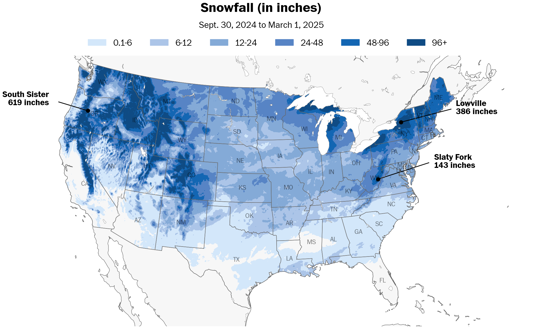
Despite several noteworthy winter storms, including a rare Gulf Coast snowstorm that brought a foot of snow to parts of New Orleans, snowfall was below average in 67 percent of the United States.

This is generally consistent with predictions that suggested below-average snowfall would be common this winter.Related video: Arctic Weather Set For US: What Is A Polar Vortex? (unbranded – Newsworthy)

about:blank

Video Player is loading.

unbranded – Newsworthy

Arctic Weather Set For US: What Is A Polar Vortex?

Places that experienced the greatest snowfall compared to average include eastern Texas, southern Louisiana, southern Mississippi, southern Alabama, Georgia, eastern South Carolina and eastern North Carolina as well as southeastern Oklahoma, northern Arkansas, New York’s Tug Hill Plateau and eastern Oregon.

Meanwhile, the largest snowfall deficits were found in the Dakotas, Nebraska, Iowa, Minnesota, Wisconsin, Illinois, New Jersey, Connecticut, Rhode Island, Massachusetts and western parts of the Carolinas.Snow fell in parts of every state this winter, with some of the heaviest totals in Oregon and New York.

Snow fell in parts of every state this winter, with some of the heaviest totals in Oregon and New York.© Ben Noll/The Washington Post/NOAA

The snowiest place in the western United States this season was the South Sister, a mountain west of Bend, Oregon, where a total of 619 inches fell.

In the East, the snowiest place was to the west of Lowville, New York, in the Tug Hill Plateau — where 386 inches fell. Areas near the Great Lakes were spectacularly snowy this winter because of frigid air masses crossing record warm lake water.

Parts of all 50 states experienced snow this winter.

What’s to come
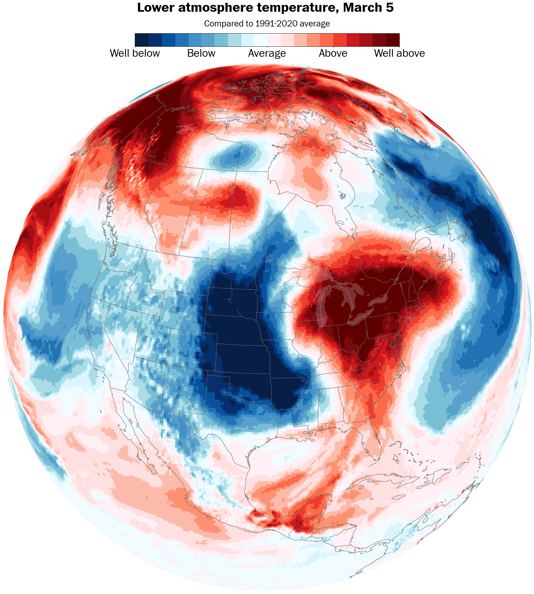
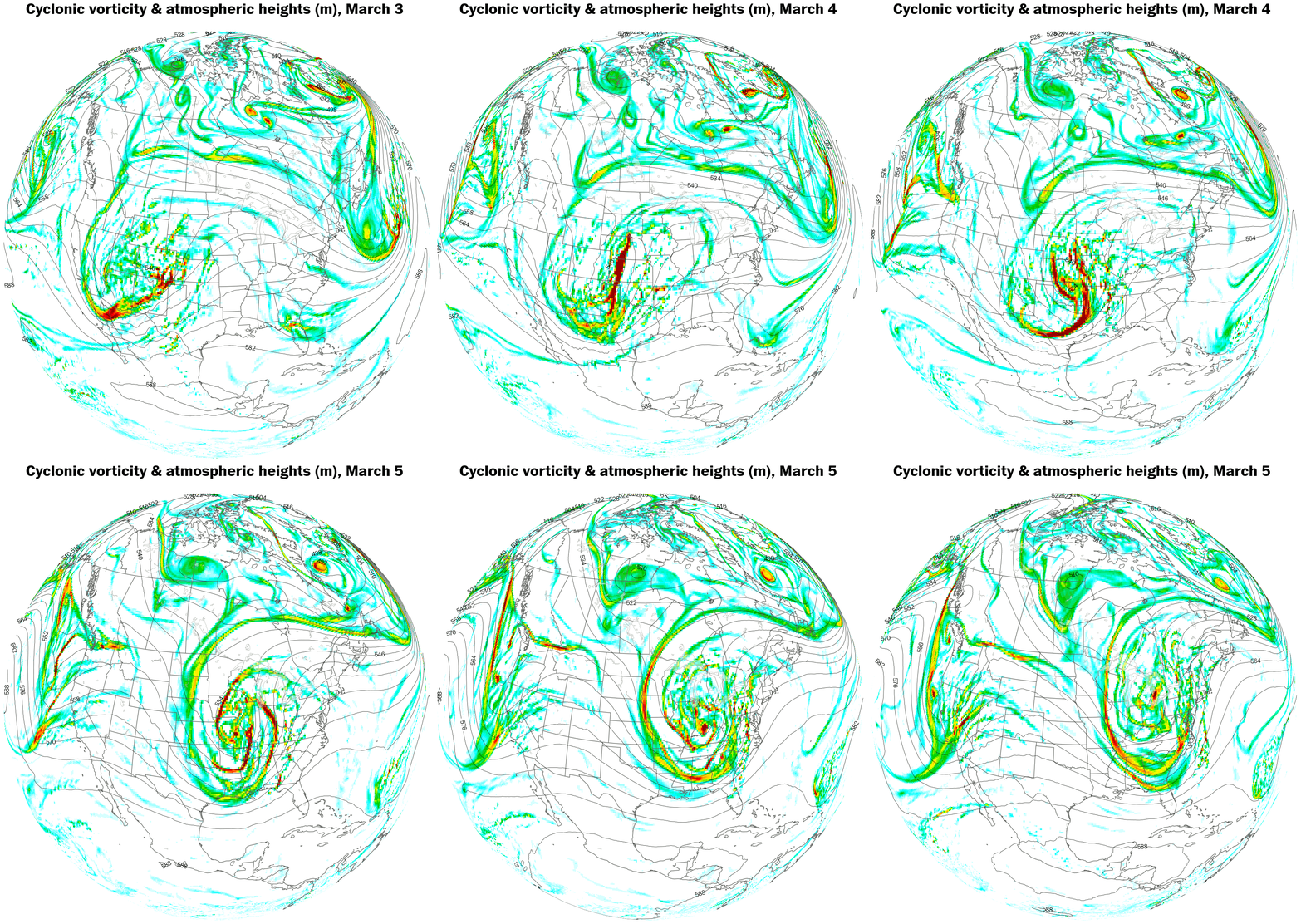
Large temperature differences across the United States will fuel a dynamic storm this week.

Large temperature differences across the United States will fuel a dynamic storm this week.© Ben Noll/Data source: ECMWF/ERA5

The week ahead will have severe weather, strong winds, the potential for blizzard conditions and a temperature roller coaster across the United States.

Large temperature differences will fuel a dynamic midweek storm. An atmospheric disturbance, resembling a bowling ball, will swirl across the country.An atmospheric disturbance resembling a bowling ball will fuel severe weather across the country this week.

An atmospheric disturbance resembling a bowling ball will fuel severe weather across the country this week.© Ben Noll/Data source: ECMWF

A few tornadoes may form across the South on Tuesday, with Louisiana, Arkansas and Mississippi under an enhanced risk (level 3 out of 5) from the National Weather Service Storm Prediction Center. Hail and damaging winds are expected to add to the dangerous conditions.

As the storm sweeps east, it will bring a period of heavy rain and gusty winds to many states on Wednesday. Strong winds may continue in the East through Friday, potentially resulting in sporadic power outages.

On the backside of the intense storm, blizzard conditions are possible in the Plains and Midwest from late Tuesday through Wednesday, including Kansas, Nebraska, Iowa, Minnesota, Wisconsin and Michigan. This could cause dangerous and disorienting travel conditions.

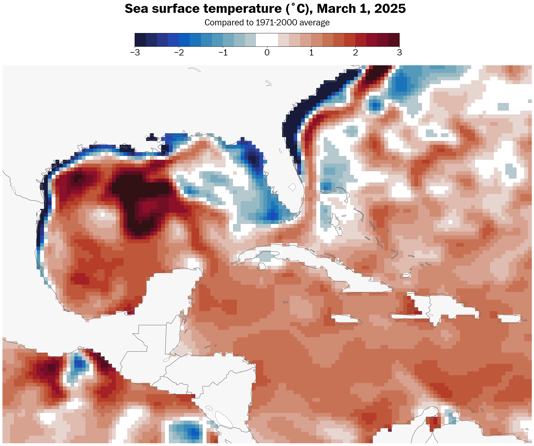
Influencing the strength of the system is a record warm patch of ocean water in the western Gulf of Mexico.

This warm water could influence a significant warm-up in the United States during the week of March 10, with meteorological spring in full swing.A record warm patch of ocean water in the western Gulf of Mexico will fuel severe weather and influence unusually warm conditions at times.

A record warm patch of ocean water in the western Gulf of Mexico will fuel severe weather and influence unusually warm conditions at times.© Ben Noll/The Washington Post/NOAA

The statistical analysis in this piece is based upon NOAA atmospheric reanalysis dataECMWF reanalysis data and NOAA snowfall data.

Why Wisconsin Faces More Frequent Polar Vortex Events

https://www.msn.com/en-us/weather/topstories/why-wisconsin-faces-more-frequent-polar-vortex-events/ar-AA1A3kbU?ocid=msedgntp&pc=LCTS&cvid=3025eb4bc2ce46e4a95fb6e97a410214&ei=53

Climate CosmosFollow

18.9K Followers

Story by B.Sc. Jessica Taylor

 • 1d • 

4 min read

Geographic Location

Geographic Location (image credits: pexels)

Geographic Location (image credits: pexels)© Geographic Location (image credits: pexels)

Wisconsin, nestled in the northern reaches of the United States, finds itself uniquely positioned to experience the whims of Arctic air masses. This geographic location makes it particularly susceptible to polar vortex events.

Imagine Wisconsin as a northern sentinel, standing guard against the cold breezes that sweep down from the Arctic. The proximity to Canada means that Wisconsin often serves as a gateway for these frigid air masses heading south.

This position on the map is not just a point of interest but a significant factor that shapes the state’s weather patterns. The cold air doesn’t just visit; it sometimes overstays its welcome, leading to prolonged cold spells that can catch residents off guard.

In essence, Wisconsin’s location is like being on the frontline of a cold war where nature dictates the terms.

Climate Change Effects

Climate Change Effects (image credits: pixabay)

Climate Change Effects (image credits: pixabay)© Climate Change Effects (image credits: pixabay)

Climate change is a global phenomenon, yet its fingerprints can be found in the local weather patterns of regions like Wisconsin. As the Arctic warms at an accelerated pace, it causes disruptions in atmospheric patterns, which can lead to more frequent and severe polar vortex events.Related video: What the Polar Vortex Will Do to Earth this Decade (Astrum)

about:blank

minor analogita sehligwa in these are fans Azaria Cinti Armen

Astrum

What the Polar Vortex Will Do to Earth this Decade

More videos

It’s as if the usual rhythm of nature’s dance has been thrown off balance, causing unexpected and sometimes extreme weather conditions. This warming alters the temperature gradients between the Arctic and the mid-latitudes, which could be nudging the polar vortex to behave differently.

Scientists suggest that as the Arctic ice melts, it doesn’t just raise sea levels but also meddles with the atmospheric currents that affect weather patterns thousands of miles away. For Wisconsin, this means an increase in the frequency and intensity of cold snaps that can disrupt everyday life.

Jet Stream Dynamics

Jet Stream Dynamics (image credits: wikimedia)

Jet Stream Dynamics (image credits: wikimedia)© Jet Stream Dynamics (image credits: wikimedia)

The polar vortex is closely linked to the jet stream, a fast-flowing ribbon of air high in the atmosphere. During winter, the jet stream can become wavier, allowing cold Arctic air to spill southward into regions like Wisconsin.

Picture the jet stream as a giant river in the sky; when it meanders, it can carry icy air from the top of the world right into America’s heartland. This waviness disrupts the usual flow of air, leading to sudden and severe temperature drops.

The jet stream doesn’t just influence temperature; it also impacts weather systems, potentially bringing storms and heavy snow. For Wisconsin, a wavy jet stream can mean the difference between a mild winter day and a bone-chilling freeze.

Understanding these dynamics is crucial for predicting and preparing for the polar vortex’s icy grip.

Temperature Gradients

Temperature Gradients (image credits: pixabay)

Temperature Gradients (image credits: pixabay)© Temperature Gradients (image credits: pixabay)

The stark contrast between warm southern air and cold Arctic air creates a battleground in the atmosphere, often leading to instability. This temperature gradient is a key player in triggering polar vortex disruptions.

Imagine two opposing forces meeting; this clash can create turbulence that disturbs the usual weather patterns. In Wisconsin, this can result in sharp drops in temperature and the arrival of polar vortex events.

The greater the temperature difference, the more intense the resulting weather can be. It’s like a tug-of-war in the sky, where the push and pull of different air masses can dictate the weather on the ground.

Residents of Wisconsin may find themselves caught in these atmospheric skirmishes, experiencing weather that swings from one extreme to another.

Landforms and Lake Effects

Landforms and Lake Effects (image credits: pixabay)

Landforms and Lake Effects (image credits: pixabay)© Landforms and Lake Effects (image credits: pixabay)

Wisconsin’s landscape, with its rolling hills and proximity to the Great Lakes, plays a critical role in shaping local weather conditions. The Great Lakes, in particular, can amplify the effects of polar vortex events through phenomena like lake-effect snow.

As cold air moves over the relatively warmer waters of the lakes, it picks up moisture and dumps it as snow on the leeward side. This can lead to heavy snowfall in certain areas, adding another layer of complexity to Wisconsin’s winter weather.

The varied landforms can also create pockets of cold air that linger longer than expected. It’s as if the state’s geography conspires with the polar vortex to create a winter wonderland, albeit one that can be treacherous and challenging.

Understanding these local effects is crucial for residents and forecasters alike.

Historical Weather Patterns

Historical Weather Patterns (image credits: flickr)

Historical Weather Patterns (image credits: flickr)© Historical Weather Patterns (image credits: flickr)

An examination of historical weather data reveals that Wisconsin has experienced an uptick in polar vortex events in recent years. This trend towards more extreme winter weather is not just a statistical anomaly but a reality that residents have had to confront.

These events are becoming a more regular feature of Wisconsin’s climate, leading to colder, longer winters. The historical record serves as a stark reminder that the state’s weather patterns are changing, with polar vortex events becoming more frequent.

Residents might recall recent winters where the cold seemed relentless, a testament to this emerging pattern. This historical perspective is vital for understanding the future of Wisconsin’s climate and preparing for the challenges it may bring.

Local Vulnerability

Local Vulnerability (image credits: flickr)

Local Vulnerability (image credits: flickr)© Local Vulnerability (image credits: flickr)

Wisconsin’s infrastructure, agriculture, and ecosystems are not immune to the impacts of polar vortex events. The state’s economy and daily life can be significantly affected by these cold snaps.

For instance, prolonged cold can strain heating systems, disrupt transportation, and damage crops, leading to economic losses. The vulnerability extends beyond just the human population; local wildlife and ecosystems can also suffer.

The increasing frequency of polar vortex events has raised public awareness and concern, prompting discussions on how best to adapt and mitigate the impacts. It’s a reminder that while the polar vortex is a natural phenomenon, its effects are very much a human concern.

This growing awareness is crucial for fostering resilience in the face of changing weather patterns.

What do you think about this topic? Share your thoughts in the comments below — we’d love to hear from you! Want more stories like this? Follow us and never miss out!

Several deaths reported in winter storm that brought historic snow to the South

Default Mono Sans Mono Serif Sans Serif Comic Fancy Small CapsDefault X-Small Small Medium Large X-Large XX-LargeDefault Outline Dark Outline Light Outline Dark Bold Outline Light Bold Shadow Dark Shadow Light Shadow Dark Bold Shadow Light BoldDefault Black Silver Gray White Maroon Red Purple Fuchsia Green Lime Olive Yellow Navy Blue Teal Aqua OrangeDefault 100% 75% 50% 25% 0%Default Black Silver Gray White Maroon Red Purple Fuchsia Green Lime Olive Yellow Navy Blue Teal Aqua OrangeDefault 100% 75% 50% 25% 0%From Texas through the Deep South, down into Florida and to North Carolina’s Outer Banks, the snow and ice made for dangerous driving. (CNN, Louisiana DOTD, WPMI, WALA, Myrtle Beach City Government, WANF, WXXV, Pete Ferguson, FL511, Florida Department of Transportation, EarthCam, WECT, KPRC)

By Dorothy Sedovic

Published: Jan. 23, 2025 at 9:05 AM PST|Updated: 3 hours ago

(Gray News) – Authorities have reported several deaths attributed to a major winter storm that brought record-breaking snow and freezing temperatures to the southern U.S.

Parts of Texas, Gulf Coast and the Deep South were hit with snow and sleet Wednesday, bringing extreme conditions to areas unaccustomed with wintry weather.

At least eight people have died throughout the South in connection to the winter storm.

EN ESPAÑOL: Reportan varios muertos debido a histórica tormenta de nieve en el sur de EE.UU.

Five people were killed in a collision caused by icy conditions in Texas Tuesday morning. According to the Texas Department of Safety, a tractor-trailer had collided with several vehicles on an icy road southwest of San Antonio.

Authorities are investigating the deaths of two people found in the cold in Austin, Texas, according to CNN. Although it is suspected cold exposure led to their deaths, the medical examiner’s office has not released the official cause of death.

In Georgia, officials have reported at least one person had died from hypothermia.

Other parts of the U.S. were also impacted by the extreme winter weather. Temperatures across the Midwest plunged well below freezing as an Arctic blast pushed through the area.

The death of an 80-year-old man in Milwaukee was likely caused by hypothermia, according to the medical examiner’s office.

Pacific Northwest Faces ‘Once-in-a-Decade’ Snowfall: Bomb Cyclone Meets Atmospheric River

Daily GalaxyFollow

3.3K Followers

Story by Arezki Amiri

 • 2h • 2 min read

Pacific Northwest Faces ‘Once-in-a-Decade’ Snowfall: Bomb Cyclone Meets Atmospheric River© Daily Galaxy

The Pacific Northwest is preparing for a series of impactful weather systems this week, bringing powerful winds, heavy rainfall, and significant snowfall. This weather event includes a bomb cyclone and an atmospheric river, promising widespread effects across the region and parts of California.

Bomb Cyclone and Atmospheric River in the Pacific Northwest

bomb cyclone, characterized by a rapid drop in air pressure (more than 60 millibars in 24 hours), is set to drive winds of up to 75 mph (120.7 km/h) across northern CaliforniaOregon, and Washington starting Tuesday. These winds are expected to cause widespread power outages and tree damage.

Following this, an atmospheric river—a concentrated corridor of moisture—will sweep through California’s Redwood Coast and northern mountains. This will lead to:

Rainfall totals: 5-10+ inches in some areas.

Flooding and mudslides, particularly on Thursday as the system intensifies.

The National Weather Servicehas issued flood watches across regions like the Sacramento Valley, while urging residents to avoid travel in hazardous conditions.Forecasted snowfall for the western United States, November 18-24, 2024. Photo: WeatherBell/Powderchasers

Forecasted snowfall for the western United States, November 18-24, 2024. Photo: WeatherBell/Powderchasers© Daily Galaxy

Snowfall impacts in the Pacific Northwest and California

Pacific Northwest Summit Snowfall Totals (by November 24)

Mt. Baker: 48-60″

Mt. Rainier: 55-80″

Mt. Hood: 40-60″

Mid-Mountain Snowfall Totals (November 19-24)

Crystal Mountain: 22-32″

Timberline: 20-34″

Mt. Bachelor: 25-35″

California Snowfall Totals (November 20-24)

Two systems will bring rain and snow to California, starting mid-week:

November 20-21: Snow levels will rise from 5,000 feet (1.52 km) to 9,000 feet (2.74 km), turning snow into rain at many resorts:

November 22-24: A second storm will reverse the pattern, starting with rain and ending with snow as levels drop to 4,000 feet (1.22 km):Total expected snowfall accumulation through November 20, 2024. Photo: WeatherBell/Powderchasers

Total expected snowfall accumulation through November 20, 2024. Photo: WeatherBell/Powderchasers© Daily Galaxy

Broader effects across the West

Wyoming’s Tetons: Up to 12″ of snow.

Northwestern Colorado: 2-6″ expected by Sunday.

Utah: Snowfall starting Saturday, with accumulations of 25-35″ in the Cottonwoods by mid-week.

The third weather system could bring more than 10–20 inches of snow early next week to the Pacific Northwest and California as the storms progress. Residents and travelers should remain vigilant and follow updates as conditions evolve.