Angry oceans set records on West Coast

USA TODAY

2.2M Followers

Story by Dinah Voyles Pulver, USA TODAY

 •

January 2026 started with remarkable weather, including record temperatures, dramatic high tides and news that oceans keep getting warmer.

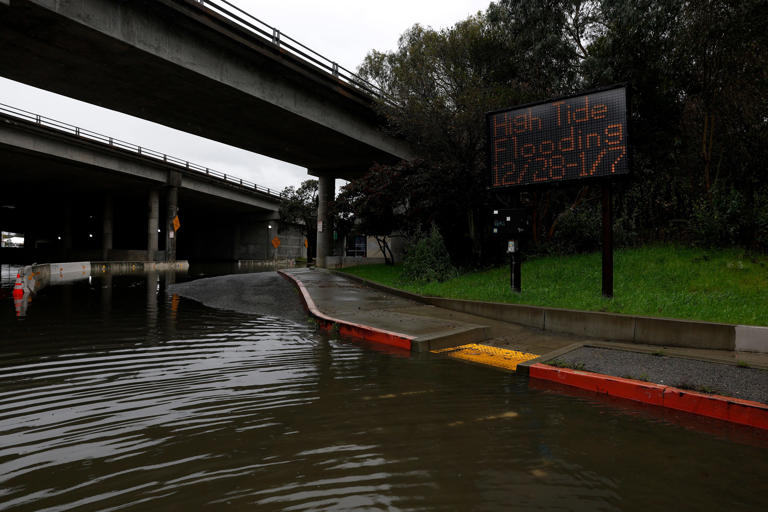
During the first weekend of the new year, record-breaking water levels occurred at 31 tidal gauges across the nation, particularly along the Pacific Coast, according to the National Oceanic and Atmospheric Administration. When the full moon was closest to the Earth on Jan. 4, higher-than-normal tides flooded low-lying areas along the California coast, where heavy rains made the flooding worse in some locations.Seniors Are Getting Bathroom Upgrades

Seniors Are Getting Bathroom Upgrades

Fetchapro

·

Sponsored

call to action icon
more

A key factor driving some of the increasing weather extremes, including coastal flooding, is the world’s warming oceans, said Michael Mann, a climate scientist and professor at the University of Pennsylvania. Mann was one of a group of 55 scientists around the world who co-authored an ocean warming study published Jan. 9 in the journal Advances in Atmospheric Science.

Start the day smarter. Get all the news you need in your inbox each morning.

“Both the warming of the oceans and the ocean surface are playing a role in the extreme weather that we continue to see, as warming oceans evaporate more moisture into the atmosphere, driving the record flooding we are seeing, the more intense and damaging hurricanes, and the melting ice, rising sea level and coastal inundation,” Mann told USA TODAY.

Meanwhile, at least a half-dozen warm temperature records were set on New Year’s Day, according to NOAA’s National Weather Service. The warmth followed a December that broke or tied so many monthly warm high or overnight warm low temperature records that it accounted for nearly 20% of all the monthly warm records set or tied in 2025.Related video: Ocean temps reach new record in 2025: What it means for Minnesota (FOX 9 Minneapolis-St. Paul)

Because recent international analysis found that the Earth’s ocean stored

Current Time 0:01

/

Duration 12:54

FOX 9 Minneapolis-St. Paul

Ocean temps reach new record in 2025: What it means for Minnesota

0

View on Watch

Warm temperature records

Warm temperature records continue to be broken right and left.

In the Sioux Falls, South Dakota, weather service region, a half-dozen new records were set on Jan. 13, the weather service office reported. The 36-degree overnight low temperature at Sioux Falls was 9 degrees warmer than the normal high temperature for the date and 28 degrees warmer than the normal low. At least four other weather stations in the region reported similar overnight lows that were several degrees warmer than the typical high.

NOAA and other leading scientific organizations reported on Jan. 14 that 2025 was the third warmest year on record since measurements began in 1850. Each of the last 11 years is among the 11 warmest years on record.

“You’re going to see more warm than cold records, because the climate is getting warmer,” said Alan Gerard, a veteran meteorologist who writes the “Balanced Weather” blog on Substack.Selling Your RV? - Find Your Rv Value Now

Selling Your RV? – Find Your Rv Value Now

RVBlueBooks.com

·

Sponsored

call to action icon
more

High tides

Record water levels occurred in some California locations during January’s full moon high tides.

In San Francisco, the tide was the fourth highest since records began in 1898. Record high tides were reported in Santa Barbara, Richmond, Martinez-Amorco and Redwood City. Widespread coastal street flooding occurred in King Salmon and elsewhere along the coast in Humboldt County, California, the weather service said. Flooding also was reported in San Diego.

Federal scientists expect such flooding to become more frequent over time with higher sea levels. NOAA’s annual high tide outlook predicts the North Spit location in Humboldt County and San Diego could experience the highest number of flood days along the Southwest Pacific Coast in 2026. Even using the lowest available sea level rise projections, the total number of high tide flooding days in the two locations is forecast to double between 2020 and 2030.A parking lot floods on Jan. 5, 2026 in Mill Valley, California after high tides in the San Francisco Bay Area.

A parking lot floods on Jan. 5, 2026 in Mill Valley, California after high tides in the San Francisco Bay Area.© Justin Sullivan, Getty Images

Warmer oceans

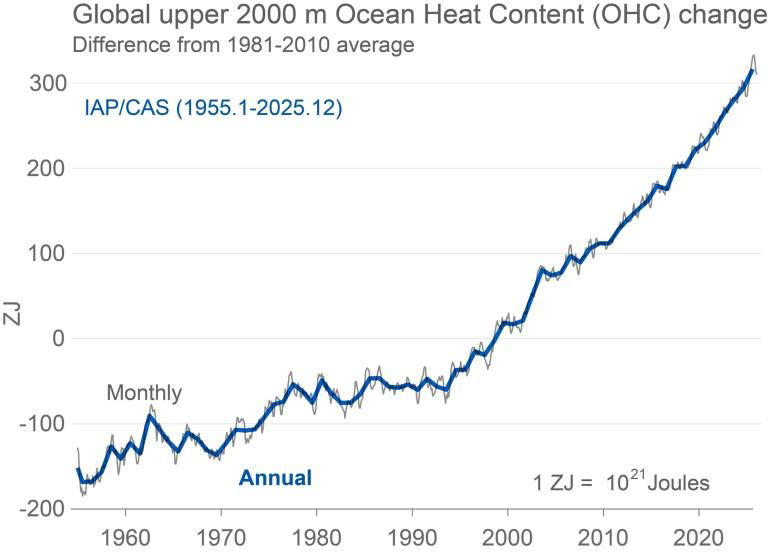
Ocean heat content continued to set records globally in 2025, with “broad ocean warming across basins,” the team of researchers reported in the study Mann participated in. The warming continued “in response to increased greenhouse gas concentrations and recent reductions in sulfate aerosols, reflecting the long-term accumulation of heat within the climate system.”Monthly and annual changes in heat content in the upper 6,500 feet of the ocean from 1955 through 2025, shown as the difference from the average between 1981 to 2000.

Monthly and annual changes in heat content in the upper 6,500 feet of the ocean from 1955 through 2025, shown as the difference from the average between 1981 to 2000.© Provided by World Meteorological Organization

Unlike sea surface temperatures that can fluctuate substantially, ocean heat content – which measures the warming below the surface of the ocean over the full ocean depth – shows a very steady warming trend, Mann said. “Though this year was not a new record for global surface temperatures, it was a record for ocean heat content.”Redhead Sherpa-Lined Plaid Long-Sleeve Shirt For Men - Olive Plaid - M

Redhead Sherpa-Lined Plaid Long-Sleeve Shirt For Men – Olive Plaid – M

Cabela’s

·

Sponsored

call to action icon
more

Each of the past nine years has set a new record, Mann said. In 2025, about 33% of the global ocean area ranked among the top three warmest conditions since records began in 1958, while about 57% was within the top five, their study reported.

NOAA reported in a 2025 climate summary that the Antarctic saw its warmest annual temperature on record, while the Arctic annual temperature was the second warmest.

Intense rain

A bevy of scientists have reported the warming oceans also help drive more intense rainfall. That’s especially true for the Gulf of America, renamed from the Gulf of Mexico by President Donald TrumpUSA TODAY has previously reported. The warming Gulf helps move more moisture northward in an arc up and over the central and eastern U.S.

Leadgen logoUSA TODAY

Get unlimited digital access to USA TODAY and premium Sports+ storiesOne month freeGet it now

On Jan. 8, La Farge, Wisconsin, was one of more than a dozen locations within the La Crosse weather service region that set new records for 24-hour rainfalls in the month of January. The 2.29 inches of rain in La Farge was more than an inch above the amount of rain the station normally receives during the entire month.

Dinah Voyles Pulver, a national correspondent for USA TODAY, covers climate change, weather, the environment and other news. Reach her at dpulver@usatoday.com or @dinahvp on Bluesky or X or dinahvp.77 on Signal.

This article originally appeared on USA TODAY: Angry oceans set records on West Coast

The Gulf Stream is on the Verge of Collapse, Scientists Warn of Imminent Consequences

Daily Galaxy

43.4K Followers

Story by Jessica Bennett

 • 6h • 

3 min read

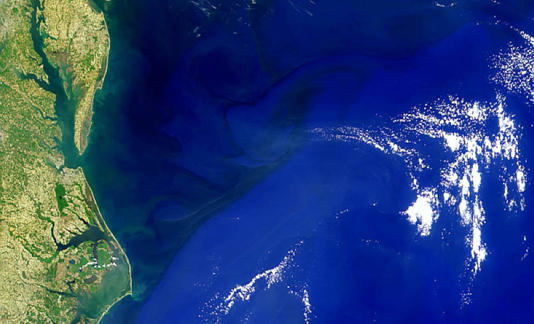
Image credit: SeaWiFS Project, NASA/Goddard Space Flight Center, and ORBIMAGE | The Daily Galaxy --Great Discoveries Channel

Image credit: SeaWiFS Project, NASA/Goddard Space Flight Center, and ORBIMAGE | The Daily Galaxy –Great Discoveries Channel© Daily Galaxy US

A groundbreaking study led by Edward Forman at the University of Southampton and James Baldini at Durham University has used the unique method of analyzing stalagmites in Bermuda’s caves to track changes in the Gulf Stream over centuries. Published in Nature Communications Earth & Environment, this research reveals crucial information about the Atlantic Meridional Overturning Circulation (AMOC) and how it might impact the climate as global temperatures continue to rise. The original study was shared by The Conversation, where the researchers discussed the long-term shifts in the Gulf Stream and its potential consequences for global weather patterns.Top 5 Wealth Management Firms In The United States

Ad

Top 5 Wealth Management Firms In The United States

Smart Asset

call to action icon

The Role of Stalagmites in Climate Research

Stalagmites, typically known for their beauty and geological interest, have proven to be essential in studying past climate patterns.The cave systems in Bermuda contain mineral deposits that grow slowly, gaining only a millimeter every few years. These deposits, called speleothems, carry chemical traces of the water that drips from the ceiling of the caves. By analyzing these stalagmites, scientists can indirectly reconstruct past sea surface temperatures, providing insights into how ocean currents and regional climates have shifted over long periods.

The researchers found that during colder periods, increased wind speeds lead to more sea spray, which then becomes part of the mineral deposits in the stalagmites. “Analysing the chemistry of one of these stalagmites has thus enabled us to indirectly reconstruct past sea surface temperatures,” the researchers said. This method opens up a window into understanding how the Gulf Stream has behaved over the last several centuries, adding critical depth to our understanding of ocean circulation and its links to regional and global climates.Image

Image© Daily Galaxy US

Gulf Stream Shifts and the AMOC: A Century-Old Pattern

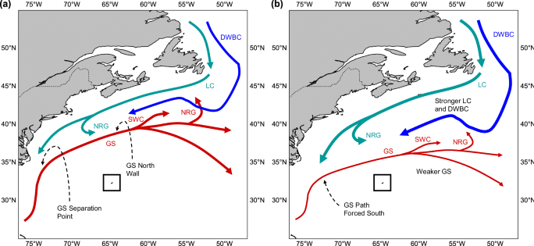
The Gulf Stream, one of the most powerful ocean currents, has played a pivotal role in shaping the climate of Western Europe and parts of North America. The warm water flowing from the Gulf of Mexico northward helps to regulate temperatures across the North Atlantic, especially for countries in Western Europe. As the Gulf Stream reaches colder latitudes, the water cools and sinks, eventually flowing back southward. Together, these processes form part of the AMOC, a system vital for maintaining global climate balance.Tailgate Handle Rear View Backup Camera For 2004-14 Ford F150 08+ F250

Ad

Tailgate Handle Rear View Backup Camera For 2004-14 Ford F150 08+ F250

eBay

call to action icon

Using the data from the Bermuda stalagmites, the research team traced the movement of the Gulf Stream back to 1449. The data revealed that around 300 years ago, the Gulf Stream shifted northward, coinciding with the weakening of the AMOC. This finding suggests that the AMOC may have been weakening long before the onset of industrialization and rising global temperatures, raising concerns that the system could be more sensitive to changes than previously thought. If the AMOC continues to weaken, it could lead to significant disruptions in weather patterns across the globe.Image

Image© Daily Galaxy US

A Warning for Future Climate Change

One of the most important takeaways from this research is the potential consequences of a continuing weakening of the AMOC. Climate models suggest that as global temperatures rise above 1.5°C, the AMOC could experience further destabilization, with some models predicting a collapse of the system within this century. The Intergovernmental Panel on Climate Change (IPCC) has estimated that there is up to a 10% chance of AMOC collapse by 2100, but recent findings suggest that this risk might be even higher.Vintage Citizen Altichron 7240-F20003-Nos Full Set

Ad

Vintage Citizen Altichron 7240-F20003-Nos Full Set

eBay

call to action icon

The researchers point out that even small shifts in ocean circulation can have significant effects on regional climates. “A sustained movement of the Gulf Stream would lead to changing regional temperatures, rainfall patterns and more extreme weather,” they conclude. Such shifts could be particularly devastating for regions that rely on stable weather patterns for agriculture and natural resources. “This could have serious implications for wildlife and food security, as ecosystems struggle to adapt to the changing climate,” they added. This underscores the urgent need for understanding and addressing the long-term impacts of climate change on critical ocean systems like the Gulf Stream.

Enjoyed this article? Subscribe to our free newsletter for engaging stories, exclusive content, and the latest news.

For more news like this, visit Dailygalaxy.com.

Millions in 11 states told to stay inside

Newsweek

2.5M Followers

Story by Joe Edwards

 • 4h • 

2 min read

Heat map

Heat map© Newsweek

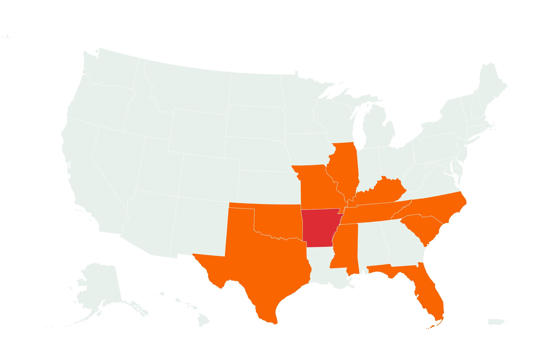
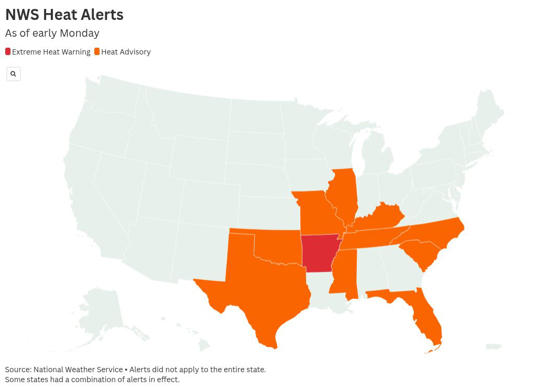
Heat-related warnings from the National Weather Service (NWS) were in effect for parts of 11 states on Friday morning, with officials advising residents in affected areas to keep out of the sun as hot temperatures and high humidity could trigger heat illnesses.map visualization

map visualization

Why It Matters

According to the Centers for Disease Control and Prevention (CDC), extreme heat can lead to heat-related illnesses, especially in older adults, young children and those with chronic medical conditions.

Symptoms may include heavy sweating, muscle cramps, dizziness and nausea. The CDC says more than 700 people die each year in the U.S. because of extreme heat.Lectric ONE Long-Range Commuter Ebike | Best Lightweight Ebike With World-Class Technology | Pinion Gear Box And Gates Belt Drive

Ad

Lectric ONE Long-Range Commuter Ebike | Best Lightweight Ebike With World-Class Technology | Pinion Gear Box And Gates Belt Drive

Lectric eBikes Store

call to action icon

Additionally, rising temperatures can worsen ground-level ozone pollution, which presents additional health risks.

What To Know

An extreme heat warning, which the NWS issues when “extremely dangerous heat conditions are expected or occurring,” was in place for portions of central, eastern, north central, southeast, and southwest Arkansas.

Heat index values—which reflect how hot it feels when both temperature and humidity are taken into account—were expected to reach up to 110 degrees here, the NWS said.

“Drink plenty of fluids, stay in an air-conditioned room, stay out of the sun, and check up on relatives and neighbors,” the alert advised.

Meanwhile, less severe heat advisories were issued for eastern Oklahoma, northeastern Texas, western Tennessee, northwestern Mississippi, northeastern South Carolina, central and eastern North Carolina, as well as southern Florida.Related video: Extreme Heat Warning Issued for Friday (KARK Little Rock)

Current Time 0:03

/

Duration 1:29

KARK Little Rock

Extreme Heat Warning Issued for Friday

0

View on Watch

Heat advisories also covered western Kentucky, southern Illinois, and southeastern Missouri.

All of these areas were expected to see heat index values in the triple-digits, according to the NWS.

What People Are Saying

The National Weather Service forecast office, Little Rock, Arkansas said on X, Thursday: “Warm overnight temps will lead to another hot day for many locations on Friday. Heat index values may exceed 110 in places however increasing PM clouds may hamper overall warming. Clouds may occupy portions of E, SE, & S AR owing to lower heat indices during the afternoon.”

NWS Miami said on X, Friday: “A heat advisory has been issued today from 11am-6pm as heat index values climb to the 105-110 degree range. Strongest heat is expected for Gulf Coast areas due to an easterly flow. Stay hydrated and take frequent breaks if required to be outside for long periods!”Turn Off Ads Now

Ad

Turn Off Ads Now

Total Adblock

call to action icon

NWS Wilmington, North Carolina, said on X, Thursday: “Tomorrow marks the first day of what will be a prolonged period of particularly unpleasant hot weather. Heat Advisories are likely each day through next Monday.”

What Happens Next

At the time of writing, the extreme heat warning for Arkansas was in effect until 8 p.m. CDT on Friday.

The NWS issues regular forecast updates on its website.

Related Articles

Why winter was colder than average in the U.S., and what spring will bring

The Washington PostFollow

784.4K Followers

Why winter was colder than average in the U.S., and what spring will bring

Story by Ben Noll

 • 11h • 

4 min read

Why winter was colder than average in the U.S., and what spring will bring

Why winter was colder than average in the U.S., and what spring will bring© Ben Noll/The Washington Post/NOAA

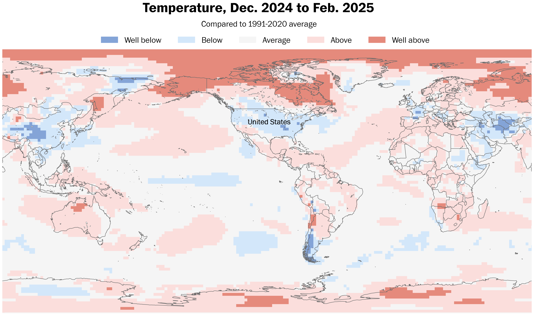
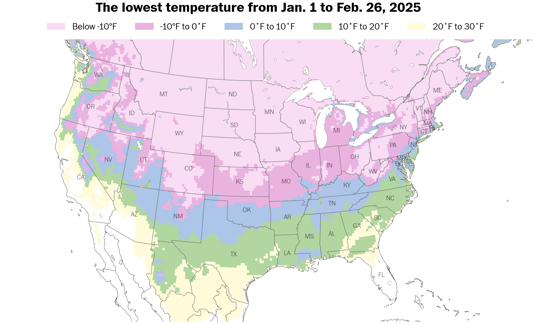
Meteorological winter, which runs from December to February, ended this weekend. Not only did it give way to meteorological spring on March 1 in the Northern Hemisphere — it ended the coldest three month period in the United States since the winter of 2013 to 2014.

It was about 1.1 degrees below average as a whole in the contiguous United States, which was home to some of the most unusually cold air on the planet — a part of western Kentucky that was almost 7 degrees colder than average.

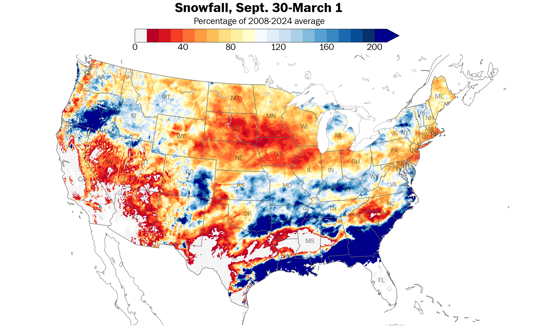
Despite the frigid temperatures, 67 percent of the country experienced below-average snowfall.

The meteorological definition for the seasons, based on historical weather statistics, differs from the astronomical definition. Astronomical spring begins on March 20.

But this next three month season will begin on a stormy, dangerous note, with severe thunderstorms and tornadoes possible in the South on Tuesday and strong winds in many regions this week, along with blizzard conditions, heavy rain and a temperature roller coaster.

An unusually cold winter

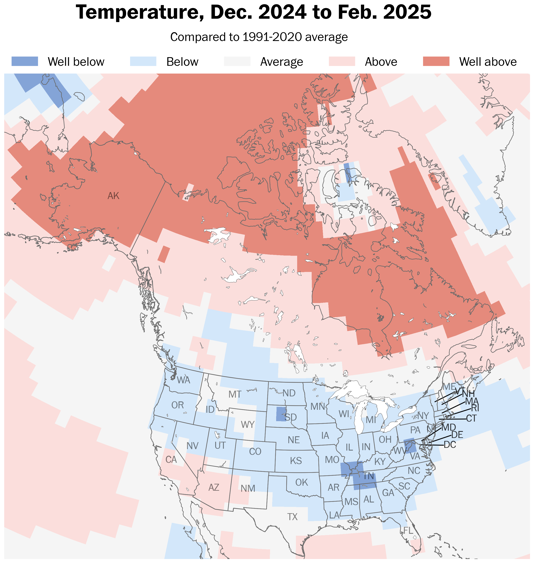
Parts of every state except Alaska and Hawaii experienced below-average temperatures this winter.

Parts of every state except Alaska and Hawaii experienced below-average temperatures this winter.© Ben Noll/The Washington Post/NOAA

Below-average temperatures covered parts of every state except Alaska and Hawaii this winter.

The most unusually cold conditions occurred in South Dakota and in a corridor that includes Illinois, Missouri, Kentucky, Tennessee, Arkansas, Mississippi, Alabama and Georgia as well as Pennsylvania, West Virginia, Maryland and Virginia.

The cold conditions were driven by high pressure in the Arctic, which caused the polar vortex to be displaced unusually far south, dislodging polar air masses into the United States.More than 111 million people across the United States have experienced subzero temperatures this year, the highest number in six years.

More than 111 million people across the United States have experienced subzero temperatures this year, the highest number in six years.© Ben Noll/The Washington Post/ECMWF/ERA5

Since the start of 2025, more than 111 million people across the United States experienced subzero temperatures, the highest number in six years.

One of the true temperature oddities of the season occurred in January when Anchorage was briefly warmer than parts of Louisiana, just 30 miles inland from the Gulf of Mexico.

The United States was part of the 8 percent of the planet that experienced below average winter temperatures. Meanwhile, 44 percent experienced above-average temperatures. Such a ratio is consistent with a warming climate.

Below-average snowfall

Below-average snowfall covered a majority of the United States this winter.

Below-average snowfall covered a majority of the United States this winter.© Ben Noll/The Washington Post/NOAA

Despite several noteworthy winter storms, including a rare Gulf Coast snowstorm that brought a foot of snow to parts of New Orleans, snowfall was below average in 67 percent of the United States.

This is generally consistent with predictions that suggested below-average snowfall would be common this winter.Related video: Arctic Weather Set For US: What Is A Polar Vortex? (unbranded – Newsworthy)

about:blank

Video Player is loading.

unbranded – Newsworthy

Arctic Weather Set For US: What Is A Polar Vortex?

Places that experienced the greatest snowfall compared to average include eastern Texas, southern Louisiana, southern Mississippi, southern Alabama, Georgia, eastern South Carolina and eastern North Carolina as well as southeastern Oklahoma, northern Arkansas, New York’s Tug Hill Plateau and eastern Oregon.

Meanwhile, the largest snowfall deficits were found in the Dakotas, Nebraska, Iowa, Minnesota, Wisconsin, Illinois, New Jersey, Connecticut, Rhode Island, Massachusetts and western parts of the Carolinas.Snow fell in parts of every state this winter, with some of the heaviest totals in Oregon and New York.

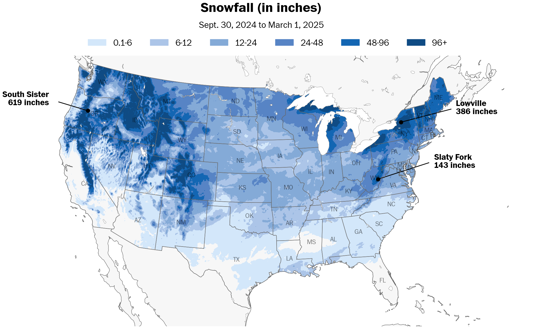
Snow fell in parts of every state this winter, with some of the heaviest totals in Oregon and New York.© Ben Noll/The Washington Post/NOAA

The snowiest place in the western United States this season was the South Sister, a mountain west of Bend, Oregon, where a total of 619 inches fell.

In the East, the snowiest place was to the west of Lowville, New York, in the Tug Hill Plateau — where 386 inches fell. Areas near the Great Lakes were spectacularly snowy this winter because of frigid air masses crossing record warm lake water.

Parts of all 50 states experienced snow this winter.

What’s to come

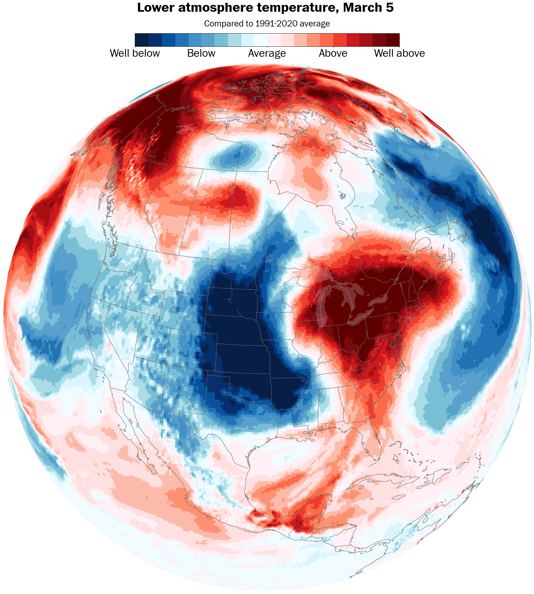
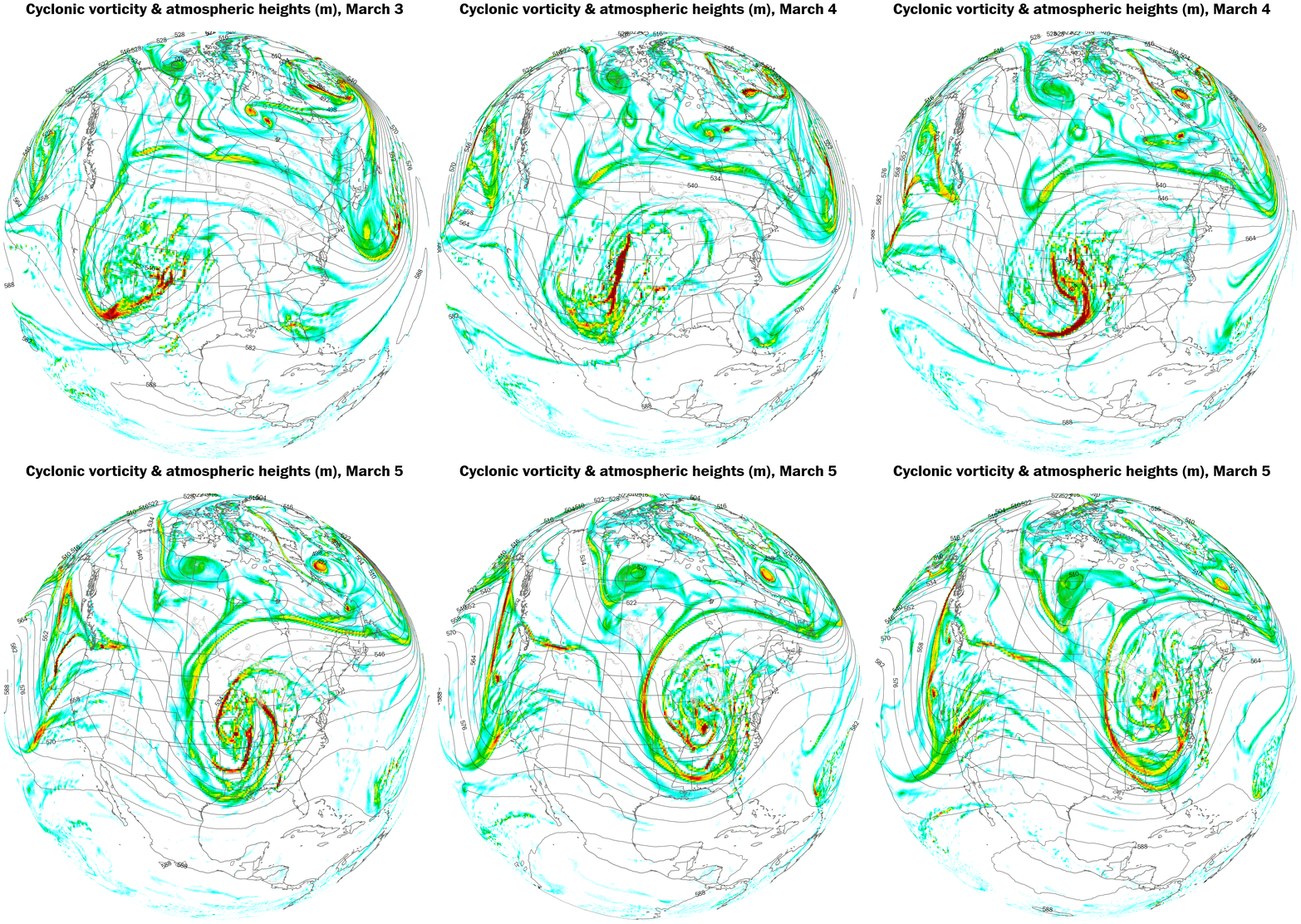
Large temperature differences across the United States will fuel a dynamic storm this week.

Large temperature differences across the United States will fuel a dynamic storm this week.© Ben Noll/Data source: ECMWF/ERA5

The week ahead will have severe weather, strong winds, the potential for blizzard conditions and a temperature roller coaster across the United States.

Large temperature differences will fuel a dynamic midweek storm. An atmospheric disturbance, resembling a bowling ball, will swirl across the country.An atmospheric disturbance resembling a bowling ball will fuel severe weather across the country this week.

An atmospheric disturbance resembling a bowling ball will fuel severe weather across the country this week.© Ben Noll/Data source: ECMWF

A few tornadoes may form across the South on Tuesday, with Louisiana, Arkansas and Mississippi under an enhanced risk (level 3 out of 5) from the National Weather Service Storm Prediction Center. Hail and damaging winds are expected to add to the dangerous conditions.

As the storm sweeps east, it will bring a period of heavy rain and gusty winds to many states on Wednesday. Strong winds may continue in the East through Friday, potentially resulting in sporadic power outages.

On the backside of the intense storm, blizzard conditions are possible in the Plains and Midwest from late Tuesday through Wednesday, including Kansas, Nebraska, Iowa, Minnesota, Wisconsin and Michigan. This could cause dangerous and disorienting travel conditions.

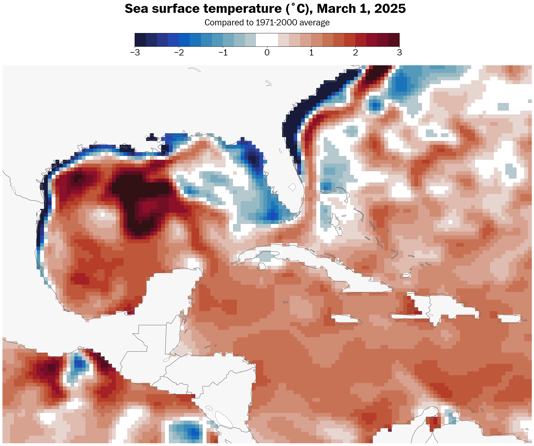
Influencing the strength of the system is a record warm patch of ocean water in the western Gulf of Mexico.

This warm water could influence a significant warm-up in the United States during the week of March 10, with meteorological spring in full swing.A record warm patch of ocean water in the western Gulf of Mexico will fuel severe weather and influence unusually warm conditions at times.

A record warm patch of ocean water in the western Gulf of Mexico will fuel severe weather and influence unusually warm conditions at times.© Ben Noll/The Washington Post/NOAA

The statistical analysis in this piece is based upon NOAA atmospheric reanalysis dataECMWF reanalysis data and NOAA snowfall data.

Why Wisconsin Faces More Frequent Polar Vortex Events

https://www.msn.com/en-us/weather/topstories/why-wisconsin-faces-more-frequent-polar-vortex-events/ar-AA1A3kbU?ocid=msedgntp&pc=LCTS&cvid=3025eb4bc2ce46e4a95fb6e97a410214&ei=53

Climate CosmosFollow

18.9K Followers

Story by B.Sc. Jessica Taylor

 • 1d • 

4 min read

Geographic Location

Geographic Location (image credits: pexels)

Geographic Location (image credits: pexels)© Geographic Location (image credits: pexels)

Wisconsin, nestled in the northern reaches of the United States, finds itself uniquely positioned to experience the whims of Arctic air masses. This geographic location makes it particularly susceptible to polar vortex events.

Imagine Wisconsin as a northern sentinel, standing guard against the cold breezes that sweep down from the Arctic. The proximity to Canada means that Wisconsin often serves as a gateway for these frigid air masses heading south.

This position on the map is not just a point of interest but a significant factor that shapes the state’s weather patterns. The cold air doesn’t just visit; it sometimes overstays its welcome, leading to prolonged cold spells that can catch residents off guard.

In essence, Wisconsin’s location is like being on the frontline of a cold war where nature dictates the terms.

Climate Change Effects

Climate Change Effects (image credits: pixabay)

Climate Change Effects (image credits: pixabay)© Climate Change Effects (image credits: pixabay)

Climate change is a global phenomenon, yet its fingerprints can be found in the local weather patterns of regions like Wisconsin. As the Arctic warms at an accelerated pace, it causes disruptions in atmospheric patterns, which can lead to more frequent and severe polar vortex events.Related video: What the Polar Vortex Will Do to Earth this Decade (Astrum)

about:blank

minor analogita sehligwa in these are fans Azaria Cinti Armen

Astrum

What the Polar Vortex Will Do to Earth this Decade

More videos

It’s as if the usual rhythm of nature’s dance has been thrown off balance, causing unexpected and sometimes extreme weather conditions. This warming alters the temperature gradients between the Arctic and the mid-latitudes, which could be nudging the polar vortex to behave differently.

Scientists suggest that as the Arctic ice melts, it doesn’t just raise sea levels but also meddles with the atmospheric currents that affect weather patterns thousands of miles away. For Wisconsin, this means an increase in the frequency and intensity of cold snaps that can disrupt everyday life.

Jet Stream Dynamics

Jet Stream Dynamics (image credits: wikimedia)

Jet Stream Dynamics (image credits: wikimedia)© Jet Stream Dynamics (image credits: wikimedia)

The polar vortex is closely linked to the jet stream, a fast-flowing ribbon of air high in the atmosphere. During winter, the jet stream can become wavier, allowing cold Arctic air to spill southward into regions like Wisconsin.

Picture the jet stream as a giant river in the sky; when it meanders, it can carry icy air from the top of the world right into America’s heartland. This waviness disrupts the usual flow of air, leading to sudden and severe temperature drops.

The jet stream doesn’t just influence temperature; it also impacts weather systems, potentially bringing storms and heavy snow. For Wisconsin, a wavy jet stream can mean the difference between a mild winter day and a bone-chilling freeze.

Understanding these dynamics is crucial for predicting and preparing for the polar vortex’s icy grip.

Temperature Gradients

Temperature Gradients (image credits: pixabay)

Temperature Gradients (image credits: pixabay)© Temperature Gradients (image credits: pixabay)

The stark contrast between warm southern air and cold Arctic air creates a battleground in the atmosphere, often leading to instability. This temperature gradient is a key player in triggering polar vortex disruptions.

Imagine two opposing forces meeting; this clash can create turbulence that disturbs the usual weather patterns. In Wisconsin, this can result in sharp drops in temperature and the arrival of polar vortex events.

The greater the temperature difference, the more intense the resulting weather can be. It’s like a tug-of-war in the sky, where the push and pull of different air masses can dictate the weather on the ground.

Residents of Wisconsin may find themselves caught in these atmospheric skirmishes, experiencing weather that swings from one extreme to another.

Landforms and Lake Effects

Landforms and Lake Effects (image credits: pixabay)

Landforms and Lake Effects (image credits: pixabay)© Landforms and Lake Effects (image credits: pixabay)

Wisconsin’s landscape, with its rolling hills and proximity to the Great Lakes, plays a critical role in shaping local weather conditions. The Great Lakes, in particular, can amplify the effects of polar vortex events through phenomena like lake-effect snow.

As cold air moves over the relatively warmer waters of the lakes, it picks up moisture and dumps it as snow on the leeward side. This can lead to heavy snowfall in certain areas, adding another layer of complexity to Wisconsin’s winter weather.

The varied landforms can also create pockets of cold air that linger longer than expected. It’s as if the state’s geography conspires with the polar vortex to create a winter wonderland, albeit one that can be treacherous and challenging.

Understanding these local effects is crucial for residents and forecasters alike.

Historical Weather Patterns

Historical Weather Patterns (image credits: flickr)

Historical Weather Patterns (image credits: flickr)© Historical Weather Patterns (image credits: flickr)

An examination of historical weather data reveals that Wisconsin has experienced an uptick in polar vortex events in recent years. This trend towards more extreme winter weather is not just a statistical anomaly but a reality that residents have had to confront.

These events are becoming a more regular feature of Wisconsin’s climate, leading to colder, longer winters. The historical record serves as a stark reminder that the state’s weather patterns are changing, with polar vortex events becoming more frequent.

Residents might recall recent winters where the cold seemed relentless, a testament to this emerging pattern. This historical perspective is vital for understanding the future of Wisconsin’s climate and preparing for the challenges it may bring.

Local Vulnerability

Local Vulnerability (image credits: flickr)

Local Vulnerability (image credits: flickr)© Local Vulnerability (image credits: flickr)

Wisconsin’s infrastructure, agriculture, and ecosystems are not immune to the impacts of polar vortex events. The state’s economy and daily life can be significantly affected by these cold snaps.

For instance, prolonged cold can strain heating systems, disrupt transportation, and damage crops, leading to economic losses. The vulnerability extends beyond just the human population; local wildlife and ecosystems can also suffer.

The increasing frequency of polar vortex events has raised public awareness and concern, prompting discussions on how best to adapt and mitigate the impacts. It’s a reminder that while the polar vortex is a natural phenomenon, its effects are very much a human concern.

This growing awareness is crucial for fostering resilience in the face of changing weather patterns.

What do you think about this topic? Share your thoughts in the comments below — we’d love to hear from you! Want more stories like this? Follow us and never miss out!

North Dakota’s cloud seeding program draws interest from around the world. Opponents want to end it

The Associated PressFollow

1M Followers

Story by JACK DURA

 • 21h • 3 min read

Cloud Seeding Ban-North Dakota

Cloud Seeding Ban-North Dakota© Jack Dura

BISMARCK, N.D. (AP) — North Dakota’s decades-long efforts to aid farmers by reshaping the weather through “cloud seeding” is facing fierce opposition in the state Capitol, where legislation could outlaw the practice, which is used across the West and has drawn global interest to one of the nation’s least populous states.US--Cloud Seeding Ban-North Dakota

US–Cloud Seeding Ban-North Dakota© Jack Dura

Cloud seeding is done by airplanes releasing tiny particles of silver iodide in clouds to reduce the size of hail and increase rainfall to help crops in the semi-arid climate. Opponents see cloud seeding as ineffective, harmful and deceitful, and point to a number of counties that have ended their participation in weather modification, as recently as last fall.Cloud Seeding Ban-North Dakota

Cloud Seeding Ban-North Dakota© Jack Dura

“We are tired of government controlling our weather,” Williams County farmer Doug Stangeland told a state Senate panel on Thursday. “It’s time that God does what he does. Let the creator of the weather do what he does.”

North Dakota’s hail suppression program is the longest-running aerial cloud seeding program in the world and has used airplanes since the early 1960s, said Darin Langerud, director of the Atmospheric Resource Division of the state Department of Water Resources.Washington Residents Get Huge Home Insurance Reduction

InsureWashington Residents Get Huge Home Insurance Reduction

Ad

The North Dakota bill introduced by Republican Sen. Todd Beard would do away with weather modification and penalize the practice as a misdemeanor offense punishable by up to 30 days in jail and/or a $1,500 fine.

Berthold-area farmer Roger Neshem, who sat on his county’s weather modification authority, said local concerns went unaddressed by officials, including flights he said were outside of permitted areas.

“I think it is a good thing to make this a misdemeanor and make it illegal,” Neshem said.

Counties sponsor the program, which is cost-shared with the state, which regulates the program. The cost is about 15 cents per acre, costing four participating counties last year a combined $800,000, Langerud said. The program usually runs June through August.

Cloud seeding is done in two counties and parts of a third, including Bowman County, where some locals touted to lawmakers its success in reducing hail losses for agriculture, homeowners and businesses. In 2016, the vast majority of voters in the county rejected abolishing their weather modification authority.The #1 Toilet Cleaning Hack I Wish I Knew Sooner

Splash CleanerThe #1 Toilet Cleaning Hack I Wish I Knew Sooner

Ad

Studies show the benefits of cloud seeding compared to non-seeded or control areas, including increased rainfall, reduced crop hail losses and higher wheat yields, Langerud said.

But other scientists say exactly how effective it is remains unclear, since atmospheric forces are huge and chaotic.

Last year, Langerud’s agency signed a pact for training, research and development with the South Korean government. Argentine and Romanian delegations also have visited North Dakota in the last two years to go through the training program to learn more.

The state’s Atmospheric Resource agency also has an agreement with the University of North Dakota’s aviation program for intern pilot training on the project, which has put more than 400 intern pilots through the program over the years, Langerud said.

The bill “would ban the exact collaboration between the private industry, the local political subdivisions and the state entities that make and have pushed North Dakota to the forefront of this industry,” Weather Modification International Vice President of Flight Operations Jody Fischer said.Washington Launches New Policy For Cars Used Less Than 50 Miles/Day

Wallet FinanceWashington Launches New Policy For Cars Used Less Than 50 Miles/Day

Ad

Langerud said misinformation is driving opposition to cloud seeding. Stangeland alleged possible environmental harms and toxicity from silver iodide.

Langerud said the materials used in cloud seeding are safe, and because silver iodide is so effective at what it does, only minuscule amounts need to be used. He noted that governance of the program is largely on the local level, and argued, “I think that’s where it should stay.”

States including California, Colorado, Idaho, Nevada, New Mexico, Texas, Utah and Wyoming, as well as Alberta in Canada, have weather modification programs, according to a handout from North Dakota’s Atmospheric Resource Board.

Several deaths reported in winter storm that brought historic snow to the South

Default Mono Sans Mono Serif Sans Serif Comic Fancy Small CapsDefault X-Small Small Medium Large X-Large XX-LargeDefault Outline Dark Outline Light Outline Dark Bold Outline Light Bold Shadow Dark Shadow Light Shadow Dark Bold Shadow Light BoldDefault Black Silver Gray White Maroon Red Purple Fuchsia Green Lime Olive Yellow Navy Blue Teal Aqua OrangeDefault 100% 75% 50% 25% 0%Default Black Silver Gray White Maroon Red Purple Fuchsia Green Lime Olive Yellow Navy Blue Teal Aqua OrangeDefault 100% 75% 50% 25% 0%From Texas through the Deep South, down into Florida and to North Carolina’s Outer Banks, the snow and ice made for dangerous driving. (CNN, Louisiana DOTD, WPMI, WALA, Myrtle Beach City Government, WANF, WXXV, Pete Ferguson, FL511, Florida Department of Transportation, EarthCam, WECT, KPRC)

By Dorothy Sedovic

Published: Jan. 23, 2025 at 9:05 AM PST|Updated: 3 hours ago

(Gray News) – Authorities have reported several deaths attributed to a major winter storm that brought record-breaking snow and freezing temperatures to the southern U.S.

Parts of Texas, Gulf Coast and the Deep South were hit with snow and sleet Wednesday, bringing extreme conditions to areas unaccustomed with wintry weather.

At least eight people have died throughout the South in connection to the winter storm.

EN ESPAÑOL: Reportan varios muertos debido a histórica tormenta de nieve en el sur de EE.UU.

Five people were killed in a collision caused by icy conditions in Texas Tuesday morning. According to the Texas Department of Safety, a tractor-trailer had collided with several vehicles on an icy road southwest of San Antonio.

Authorities are investigating the deaths of two people found in the cold in Austin, Texas, according to CNN. Although it is suspected cold exposure led to their deaths, the medical examiner’s office has not released the official cause of death.

In Georgia, officials have reported at least one person had died from hypothermia.

Other parts of the U.S. were also impacted by the extreme winter weather. Temperatures across the Midwest plunged well below freezing as an Arctic blast pushed through the area.

The death of an 80-year-old man in Milwaukee was likely caused by hypothermia, according to the medical examiner’s office.

Atmospheric Rivers Have Moved Closer to the Poles in 40 Years. Scientists Reveal How This Impacts Weather

Green MattersFollow

5.9K Followers

Story by Green Matters Staff

 • 2h • 3 min read

Atmospheric Rivers Have Moved Closer to the Poles in 40 Years. Scientists Reveal How This Impacts Weather

Atmospheric Rivers Have Moved Closer to the Poles in 40 Years. Scientists Reveal How This Impacts Weather

The adverse effects of climate change and global warming can be most dramatically observed on the extreme poles of Earth– the North and South polar regions in the Arctic Ocean and Antarctica, respectively. Even minor shifts in the global temperature result in ice melt and disbalances in the delicate polar ecosystem. Now, scientists have discovered that atmospheric rivers above the Earth’s surface have moved closer to the poles in the past 40 years. They fear such changes may impact the weather patterns and rainfall across the globe leading to unprecedented events, as per the study published in the journal Science Advances.Aerial view of cloudscape. (Representative Image Source: Pexels | Pixabay)

Aerial view of cloudscape. (Representative Image Source: Pexels | Pixabay)

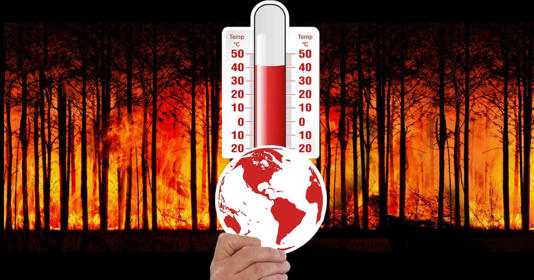
For those unversed, atmospheric rivers are long, narrow regions in the atmosphere, resembling rivers, that transport water vapor. According to NOAA, they can be over 1,000 miles long and up to 375 miles wide, flow in the direction of air, and carry the same amount of water vapor as the Mississippi River at their mouth. Atmospheric rivers take up water vapor from tropical regions and carry it across the world affecting rain and snowfall levels, particularly in cooler regions. However, the study stated that warming climates due to global warming over the years have contributed to the frequency and intensity of extreme weather patterns, which also include the movement of atmospheric rivers. The surging temperature of planet Earth with a background of flaming forests. (Representative Image Source: Pixabay | Geralt)

The surging temperature of planet Earth with a background of flaming forests. (Representative Image Source: Pixabay | Geralt)

Researchers at the University of California, Santa Barbara have estimated a 6- to 10-degree shift of the atmospheric rivers toward the poles over a time span of four decades. As a result, the areas affected by the water vapor of these rivers have also moved farther downstream, meaning farther north in the Northern Hemisphere and farther south in the Southern Hemisphere. The scientists are not sure about the chain of events that may have caused the shift, however, suggest that cooling in the eastern tropical Pacific over time is an underlying cause of the rivers moving polewards. The world’s oceans are likely to withstand unprecedented consequences due to the AR shifts.Photo of parched landscape and mountains. (Representative Image Source: Pexels | Quang Nguyen Vinh)

Photo of parched landscape and mountains. (Representative Image Source: Pexels | Quang Nguyen Vinh)

Pineapple Express is one of the famously known atmospheric rivers that play a pivotal role in the moisture levels of the West. It is responsible for fifty percent of the rain and snow on the US West Coast. The Pineapple Express delivers moisture from the tropical Pacific around Hawai’i towards the west coast of the US and Canada, causing heavy rainfall in regions including California, Oregon, Washington, and British Columbia. As a matter of concern, the atmospheric rivers moving closer to the poles can have a drastic impact on global weather patterns as several regions rely on the precipitation from these atmospheric water vapor streams. 

Droughts and heatwaves could turn into a common phenomenon in those areas whereas others may witness heavy rainfalls leading to floods and cyclones. Besides rain and flooding, the Pineapple Express also has a positive effect on snowpack increases. For instance, the winter storms caused by a series of ARs on the US West Coast in December 2010 also contributed to the snowpack in Sierras, per the NOAA report. To surmise, dry regions will have even scarce rainfall while wetter regions will experience even wetter weather. Therefore, it is essential and a need of the hour to deduce the causes behind these poleward shifts of the ARs and prepare for the adjacent consequences incoming.

Pacific Northwest Faces ‘Once-in-a-Decade’ Snowfall: Bomb Cyclone Meets Atmospheric River

Daily GalaxyFollow

3.3K Followers

Story by Arezki Amiri

 • 2h • 2 min read

Pacific Northwest Faces ‘Once-in-a-Decade’ Snowfall: Bomb Cyclone Meets Atmospheric River© Daily Galaxy

The Pacific Northwest is preparing for a series of impactful weather systems this week, bringing powerful winds, heavy rainfall, and significant snowfall. This weather event includes a bomb cyclone and an atmospheric river, promising widespread effects across the region and parts of California.

Bomb Cyclone and Atmospheric River in the Pacific Northwest

bomb cyclone, characterized by a rapid drop in air pressure (more than 60 millibars in 24 hours), is set to drive winds of up to 75 mph (120.7 km/h) across northern CaliforniaOregon, and Washington starting Tuesday. These winds are expected to cause widespread power outages and tree damage.

Following this, an atmospheric river—a concentrated corridor of moisture—will sweep through California’s Redwood Coast and northern mountains. This will lead to:

Rainfall totals: 5-10+ inches in some areas.

Flooding and mudslides, particularly on Thursday as the system intensifies.

The National Weather Servicehas issued flood watches across regions like the Sacramento Valley, while urging residents to avoid travel in hazardous conditions.Forecasted snowfall for the western United States, November 18-24, 2024. Photo: WeatherBell/Powderchasers

Forecasted snowfall for the western United States, November 18-24, 2024. Photo: WeatherBell/Powderchasers© Daily Galaxy

Snowfall impacts in the Pacific Northwest and California

Pacific Northwest Summit Snowfall Totals (by November 24)

Mt. Baker: 48-60″

Mt. Rainier: 55-80″

Mt. Hood: 40-60″

Mid-Mountain Snowfall Totals (November 19-24)

Crystal Mountain: 22-32″

Timberline: 20-34″

Mt. Bachelor: 25-35″

California Snowfall Totals (November 20-24)

Two systems will bring rain and snow to California, starting mid-week:

November 20-21: Snow levels will rise from 5,000 feet (1.52 km) to 9,000 feet (2.74 km), turning snow into rain at many resorts:

November 22-24: A second storm will reverse the pattern, starting with rain and ending with snow as levels drop to 4,000 feet (1.22 km):Total expected snowfall accumulation through November 20, 2024. Photo: WeatherBell/Powderchasers

Total expected snowfall accumulation through November 20, 2024. Photo: WeatherBell/Powderchasers© Daily Galaxy

Broader effects across the West

Wyoming’s Tetons: Up to 12″ of snow.

Northwestern Colorado: 2-6″ expected by Sunday.

Utah: Snowfall starting Saturday, with accumulations of 25-35″ in the Cottonwoods by mid-week.

The third weather system could bring more than 10–20 inches of snow early next week to the Pacific Northwest and California as the storms progress. Residents and travelers should remain vigilant and follow updates as conditions evolve.

Climate change boosted Helene’s deadly rain and wind and scientists say same is likely for Milton

0 seconds of 1 minute, 41 secondsVolume 90%

1 of 9 |  

Scientists say human-caused climate change boosted the rainfall of deadly Hurricane Helene by about 10% and intensified its winds by about 11%.

Image

2 of 9 |  

FILE – Teresa Elder walks through a flooded Sandy Cove Drive from Hurricane Helene, Sept. 27, 2024, in Morganton, N.C. (AP Photo/Kathy Kmonicek, File)

Image

3 of 9 |  

FILE – The St. Pete Pier is visible near high waves as Hurricane Helene makes its way toward the Florida panhandle Thursday, Sept. 26, 2024, in St. Petersburg, Fla. (Martha Asencio-Rhine/Tampa Bay Times via AP, File)

Image

4 of 9 |  

FILE – Arnie Bellini surveys the damages caused from Hurricane Helene on a street in Clearwater Beach, Fla., Oct. 8, 2024. (AP Photo/Chris O’Meara, File)

5 of 9 |  

FILE – Len Frisbee dumps a wheelbarrow of dirt as he helps with clean up in the aftermath of Hurricane Helene, Oct. 1, 2024, in Hot Springs, N.C. (AP Photo/Jeff Roberson, File)

6 of 9 |  

FILE – A fireman walks through mud as they search for victims of flooding in the aftermath of Hurricane Helene, Oct. 1, 2024, in Swannanoa, N.C. (AP Photo/Mike Stewart, File)

7 of 9 |  

FILE – Debris is strewn on the lake in the aftermath of Hurricane Helene, Oct. 2, 2024, in Lake Lure, N.C. (AP Photo/Mike Stewart, File)

8 of 9 |  

FILE – Resident Anne Schneider, right, hugs her friend Eddy Sampson as they survey damage left in the wake of Hurricane Helene, Oct. 1, 2024, in Marshall, N.C. (AP Photo/Jeff Roberson, File)

9 of 9 |  

FILE – An American flag sits in floodwaters in the aftermath of Hurricane Helene in the Shore Acres neighborhood Sept. 27, 2024, in St. Petersburg, Fla. (AP Photo/Mike Carlson, File)

By  ALEXA ST. JOHNUpdated 6:28 AM PDT, October 9, 2024Share

Human-caused climate change boosted a devastating Hurricane Helene ‘s rainfall by about 10% and intensified its winds by about 11%, scientists said in a new flash study released just as a strengthening Hurricane Milton threatens the Florida coast less than two weeks later.

The warming climate boosted Helene’s wind speeds by about 13 miles per hour (20.92 kilometers per hour), and made the high sea temperatures that fueled the storm 200 to 500 times more likely, World Weather Attribution calculated Wednesday from Europe. Ocean temperatures in the Gulf of Mexico were about 3.6 degrees Fahrenheit (2 degrees Celsius) above average, WWA said.

“Hurricane Helene and the storms that were happening in the region anyway have all been amplified by the fact that the air is warmer and can hold more moisture, which meant that the rainfall totals — which, even without climate change, would have been incredibly high given the circumstances — were even higher,” Ben Clarke, a study co-author and a climate researcher at Imperial College London, said in an interview.

Advertisement

Milton will likely be similarly juiced, the authors said.

Image
FILE – The St. Pete Pier is visible near high waves as Hurricane Helene makes its way toward the Florida panhandle Thursday, Sept. 26, 2024, in St. Petersburg, Fla. (Martha Asencio-Rhine/Tampa Bay Times via AP, File)

Related Stories

Hurricane Helene is unusual — but it's not an example of the Fujiwhara Effect

Hurricane Helene is unusual — but it’s not an example of the Fujiwhara Effect

Hurricane Helene makes landfall in northwestern Florida

Hurricane Helene makes landfall in northwestern Florida

Shock of deadly floods is a reminder of Appalachia’s risk from violent storms in a warming climate

Shock of deadly floods is a reminder of Appalachia’s risk from violent storms in a warming climate

The scientists warned that continued burning of fossil fuels will lead to more hurricanes like Helene, with “unimaginable” floods well inland, not just on coasts. Many of those who died in Helene fell victim to massive inland flooding, rather than high winds.

Helene made landfall in Florida with record storm surge 15 feet (4.57 meters) high and catastrophic sustained winds reaching 140 miles per hour (225.31 kilometers per hour), pummeling Georgia, the Carolinas, Tennessee and Virginia. It decimated remote towns throughout the Appalachians, left millions without power, cellular service and supplies and killed over 230 people. Search crews in the days following continued to look for bodiesHelene was the deadliest hurricane to hit the mainland U.S. since Katrina in 2005.

Advertisement

Helene dumped more than 40 trillion gallons of rain — an unprecedented amount of water — onto the region, meteorologists estimated. That rainfall would have been much less intense if humans hadn’t warmed the climate, according to WWA, an international scientist collaborative that runs rapid climate attribution studies.

“When you start talking about the volumes involved, when you add even just a few percent on top of that, it makes it even much more destructive,” Clarke said.

Image
FILE – Debris is strewn on the lake in the aftermath of Hurricane Helene, Oct. 2, 2024, in Lake Lure, N.C. (AP Photo/Mike Stewart, File)

Hurricanes as intense as Helene were once expected every 130 years on average, but today are about 2.5 times more likely in the region, the scientists calculated.

The WWA launched in 2015 to assess the extent which extreme weather events could be attributed to climate change. The organization’s rapid studies aren’t peer-reviewed but use peer-reviewed methods. The team of scientists tested the influence of climate change on Helene by analyzing weather data and climate models including the Imperial College Storm Model, the Climate Shift Index for oceans and the standard WWA approach, which compares an actual event with what might have been expected in a world that hasn’t warmed about 1.3 degrees Celsius since pre-industrial times.

Advertisement

A separate analysis of Helene last week by Department of Energy Lawrence Berkeley National Lab scientists determined that climate change caused 50% more rainfall in some parts of Georgia and the Carolinas, and that observed rainfall was “made up to 20 times more likely in these areas because of global warming.” That study was also not peer-reviewed but used a method published in a study about Hurricane Harvey.

Kim Cobb, director of the Institute at Brown for Environment and Society, wasn’t involved in either study. She said there are uncertainties in exactly how much climate change is supercharging storms like Helene, but “we know that it’s increasing the power and devastation of these storms.”

She said Helene and Milton should serve “as a wake up call” for emergency preparedness, resilience planning and the increased use of fossil fuels.

“Going forward, additional warming that we know will occur over the next 10 or 20 years will even worsen the statistics of hurricanes,” she said, “and we will break new records.”

Image
FILE – An American flag sits in floodwaters in the aftermath of Hurricane Helene in the Shore Acres neighborhood Sept. 27, 2024, in St. Petersburg, Fla. (AP Photo/Mike Carlson, File)

Advertisement

Analysis is already indicating climate change made possible the warmed sea temperatures that also rapidly intensified Milton. Clarke said the two massive storms in quick succession illustrates the potential future of climate change if humans don’t stop it.

“As we go into the future and our results show this as well, we still have control over what trajectory this goes in as to what risks we face in the future, what costs we pay in the future,” he said. “That just hinges on how we change our energy systems and how many more fossil fuels we burn.”

___

Read more of AP’s climate coverage at http://www.apnews.com/climate-and-environment